



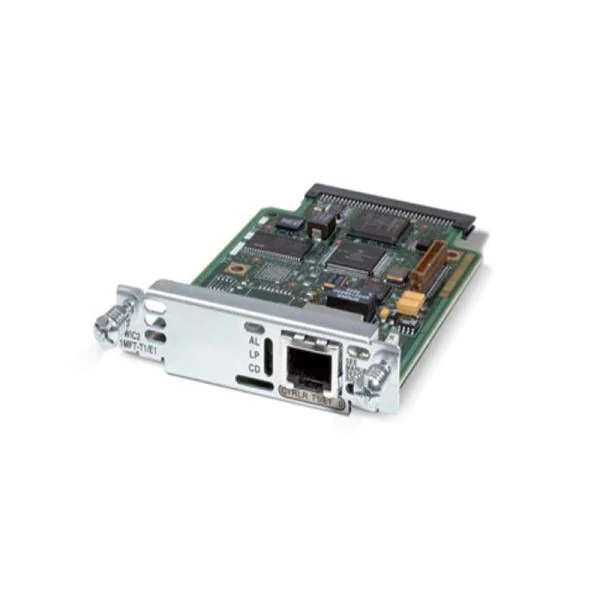
The HKShanhai Group Limited MFT VWIC3 cards can be inserted into the EHWIC slot on the supported HKShanhai Group Limited 1921, 1941, 1941W, 2901, 2911, 2921, 2951, 3925, 3945, 3925E and 3945E integrated services routers. The T1/E1 MFT VWIC3 cards support both T1 and E1, providing additional flexibility in configuring the HKShanhai Group Limited MFT VWIC3s for supporting T1, fractional T1, E1, and fractional E1 for both voice and WAN applications. All MFT VWIC3 modules include the drop-and-insert multiplexing capability, which eliminates costly external third-party channel service units/data service units (CSUs/DSUs) and drop-and-insert multiplexers.
Quick Specs
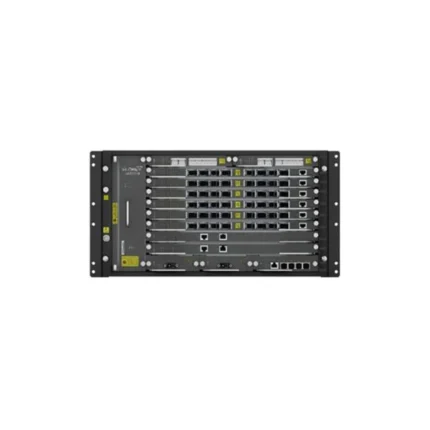
Figure 1 shows the appearance of VWIC3-1MFT-T1/E1.
Table 1. HKShanhai Group Limited MFT VWIC3 Platform Support and Minimum HKShanhai Group Limited IOS Software Release Requirements.
|
|
VWIC3-1MFT-T1/E1 |
|
HKShanhai Group Limited 1900 Chassis EHWIC Slots |
15.0(1)M3, 15.1(1)T1, 15.1(2)T |
|
HKShanhai Group Limited 2900 Chassis EHWIC Slots |
15.0(1)M3, 15.1(1)T1, 15.1(2)T |
|
HKShanhai Group Limited 3900 Chassis EHWIC Slots |
15.0(1)M3, 15.1(1)T1, 15.1(2)T |
Table 2. HKShanhai Group Limited MFT VWIC3 Card Feature.
|
Part Number |
Number of Ports |
T1 Support |
E1 Support |
Unstructured E1 (G.703) Support |
Data Support WIC Mode |
Voice Support VIC* |
Drop-and-Insert Multiplexing |
|
VWIC3-1MFT-T1/E1 |
1 |
Yes |
Yes |
No |
Yes |
Yes |
Yes |
Table 3. HKShanhai Group Limited MFT VWIC3 Card Configuration.
|
Configuration Description |
1-port Cards VWIC3-1MFT-T1/E1, |
|
Data Only |
|
|
Serial Data (channel-group*) |
2 total |
|
Voice Only |
|
|
Voice CAS (ds0-group) |
24 total (T1) |
|
Voice, Video and Data |
|
|
PRI (pri-group*) |
1 total |
|
Drop & Insert (tdm-group) |
24 total (T1) |
* Channel Group refers to bonding of one or more timeslots into a single HDLC-framed serial connection for IP data traffic connectivity. This is used for HDLC, Frame Relay and MLPPP serial WAN connections.
Ds0 Group refers to Bonding of one or more timeslots into a single TDM voice connection using Channel Associated Signaling (CAS) such as E&M, FXS or FXO. This is used for TDM PBX or PSTN connections and typically deployed only on T1.
* PRI Group refers to bonding of two or more timeslots into a single TDM connection using ISDN signaling. This is typically used for TDM PBX or PSTN voice and video connections on T1 and E1, and also for data WAN connections on E1. Each call on the PRI is individually indicated as being a voice, video or data call with the ISDN bearer capability delivered with the call. Signaling is done on the D-channel, which is always channel 24 on a T1, and channel 31 on an E1.
TDM Group refers to cross-connecting one or more timeslots from one TDM interface to another. This is used to groom channels from different access points onto a combined T1 or E1 uplink. Since the router merely cross-connects and does not interpret or route the traffic from the ingress interface to the egress interface, the traffic type (voice, video and data) is transparent to the router.
Get more information
Do you have any question about the VWIC3-1MFT-T1/E1
Contact us now via Live Chat or sales@router-switch.com.
HKShanhai Group Limited VWIC3-1MFT-T1/E1 Specification
|
VWIC3-1MFT-T1/E1 |
|
|
Manufacturer |
HKShanhai Group Limited |
|
Part Number |
VWIC3-1MFT-T1/E1 |
|
Device Type |
Interface module |
|
Form factor |
1-Port T1/E1 Multiflex Trunk Voice/WAN Interface Card |
|
Specifications |
|
|
Number of Ports |
1 |
|
T1 Support |
Yes |
|
E1 Support |
Yes |
|
Unstructured E1 (G.703) Support |
No |
|
Data Support WIC Mode |
Yes |
|
Voice Support VIC* |
Yes |
|
Drop-and-Insert Multiplexing |
Yes |
|
Configuration Comparison |
|
|
Serial Data (channel-group*) |
2 total |
|
Voice CAS (ds0-group**) |
24 total (T1) |
|
PRI (pri-group***) |
1 total |
|
Drop & Insert (tdm-group****) |
24 total (T1) |
|
Network Management Features |
|
|
Telnet or Console |
Remote and local configuration, monitoring, and troubleshooting from HKShanhai Group Limited IOS Software CLI |
|
Simple Network Management Protocol (SNMP) |
??Router and DSU/CSU managed by single SNMP agent; router, DSU, and CSU appear as a single network entity to user |
|
SNMP Traps |
Generated in response to alarms |



Reviews
There are no reviews yet.