


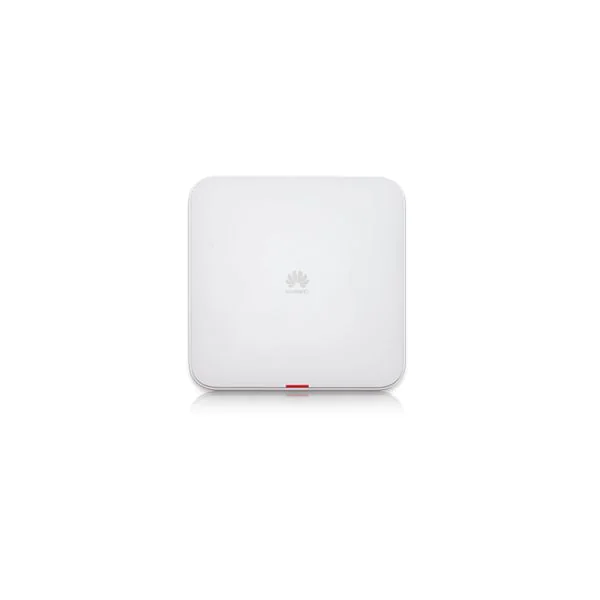
HKShanhai Group Limited AP4050DE-M is an 802.11ac Wave 2 access point (AP) that supports 2×2 MIMO and two spatial streams. It provides comprehensive service support capabilities and features high reliability, high security, simple network deployment, automatic AC discovery and configuration, and real-time management and maintenance, which meets network deployment requirements. The AP has built-in smart antennas and supports smooth evolution from 802.11n to 802.11ac and can provide gigabit access for wireless users.
Quick Spec
Table 1 shows the Quick Specs.
|
Product Code |
AP4050DE-M |
|
Dimensions (H x W x D) |
45 mm x 200 mm x 200 mm |
|
Interface type |
1 x 10/100/1000M self-adaptive Ethernet interface (RJ45) 1 x Management console port (RJ45) |
|
Built-in Bluetooth |
BLE5.0 |
|
LED indicator |
Indicates the power-on, startup, running, alarm, and fault states of the system. |
|
Power input l |
DC: 12 V 10% PoE power supply: in compliance with IEEE 802.3at |
|
Maximum power consumption
|
16.3 W NOTE The actual maximum power consumption depends on local laws and regulations. |
|
Maximum number of SSIDs for each radio |
16 |
|
Maximum number of users
|
512 NOTE The actual number of users varies according to the environment. |
Product Details
HKShanhai Group Limited AP4050DE-Mprovides these features:
802.11ac Wave 2 standards compliance, MU-MIMO (2SU-2MU), delivering services simultaneously on 2.4G and 5G radios, at a rate of up to 400 Mbit/s at 2.4 GHz, 867 Mbit/s Mbit/s at 5 GHz, and 1.267 Gbit/s for the device.
Smart antenna array technology enables targeted signal coverage for mobile terminals, reduces interferences, and improves signal quality. Additionally, it implements millisecond-level switchover as STAs move.
Built-in Bluetooth 5.0, increasing the working distance and working with eSight to accurately locate Bluetooth terminals.
Supports the Fat, Fit, and cloud modes and enables HKShanhai Group Limited cloud-based management platform to manage and operate APs and services on the APs, reducing network O&M costs
Compare to Similar Items
Table 2shows the comparison.
|
Product Code |
AP4050DE-M |
|
|
Dimensions (H x W x D) |
45 mm x 200 mm x 200 mm |
35mmx170mmx170mm |
|
Interface type |
1 x 10/100/1000M self-adaptive Ethernet interface (RJ45) 1 x Management console port (RJ45) |
2 x 10/100/1000M self-adaptive Ethernet interface (RJ45) Console interfaceRJ45 x 1 1 x USB interface |
|
Built-in Bluetooth |
BLE5.0 |
|
|
Power input |
DC: 12 V 10% PoE power supply: in compliance with IEEE 802.3at |
DC: 12 V 10% PoE power supply: in compliance with IEEE 802.3af/at (not support USB when in 802.3af) |
|
Maximum power consumption |
16.3 W |
12.3W (excluding the output power of the USB port) |
|
Antenna type |
Built-in dual-band smart antenna |
External antennas(horizontal beamwidth 360) |
|
Antenna gain |
2.4GHz: 4.5dBi 5GHz: 6dBi |
3.5 dBi (2.4 GHz); 4 dBi (5 GHz) |
Get More Information
Do you have any question about theAP4050DE-M
Contact us now via Live Chat or sales@router-switch.com.
HKShanhai Group Limited AP4050DE-M Specification
AP4050DE-M Specification |
|
|
Dimensions (H x W x D) |
45 mm x 200 mm x 200 mm |
|
Weight |
0.7 kg |
|
Interface type |
1 x 10/100/1000M self-adaptive Ethernet interface (RJ45) 1 x Management console port (RJ45) |
|
Built-in Bluetooth |
BLE5.0 |
|
LED indicator |
Indicates the power-on, startup, running, alarm, and fault states of the system. |
|
Power input l |
• DC: 12 V ± 10% • PoE power supply: in compliance with IEEE 802.3at |
|
Maximum power consumption
|
16.3 W NOTE The actual maximum power consumption depends on local laws and regulations. |
|
Operating temperature |
??span>10°C to +50°C |
|
Storage temperature |
??span>40°C to +70°C |
|
Operating humidity |
5% to 95% (non-condensing) |
|
Dustproof and waterproof grade |
IP41 |
|
Altitude |
??span>60 m to +5000 m |
|
Atmospheric pressure |
53 kPa to 106 kPa |
|
Antenna type |
Built-in dual-band smart antenna |
|
Antenna gain |
2.4GHz: 4.5dBi 5GHz: 6dBi NOTE • The gains above are the single-antenna peak gains. • The equivalent antenna gain after all 2.4 GHz or 5 GHz antennas are combined is 3dBi in 2.4 GHz or 3dBi in 5 GHz. |
|
Maximum number of SSIDs for each radio |
??16 |
|
Maximum number of users
|
??512 NOTE The actual number of users varies according to the environment. |
|
Maximum transmit power
|
2.4G: 27 dBm (combined power) 5G: 27 dBm (combined power) NOTE The actual transmit power depends on local laws and regulations. |
|
Power increment |
1 dBm |
|
Maximum number of non-overlapping channels
|
2.4 GHz (2.412 GHz to 2.472 GHz) •??02.11b/g ??20 MHz: 3 •??02.11n ??20 MHz: 3 ??40 MHz: 1 5 GHz (5.18 GHz to 5.825 GHz) •??02.11a ??20 MHz: 13 •??02.11n ??20 MHz: 13 ??40 MHz: 6 •??02.11ac ??20 MHz: 13 ??40 MHz: 6 ??80 MHz: 3 NOTE The table uses the number of non-overlapping channels supported by China as an example. The number of non-overlapping channels varies in different countries. For details, see the Country Codes & Channels Compliance. |
|
Channel rate supported l |
•??02.11b??/span>1??/span>2??/span>5.5 ??11Mbit/s •??02.11a/g??/span>6??/span>9??/span>12??/span>18??/span>24??/span>36??/span>48 and 54Mbit/s •??02.11n??/span>6.5??/span>400Mbit/s •??02.11ac wave2??/span>6.5??/span>867Mbit/s |
|
Receiver sensitivity (Typical values) |
•??.4 GHz 802.11b : -103 dBm @ 1 Mbit/s -95 dBm @ 11 Mbit/s •??.4 GHz 802.11g : -96 dBm @ 6 Mbit/s -80 dBm @ 54 Mbit/s •??.4 GHz 802.11n (HT20): 96 dBm @ MCS0 -75 dBm @ MCS15 •??.4 GHz 802.11n(HT40): -94 dBm @ MCS0 -73 dBm @ MCS15 •?? GHz 802.11a : -94 dBm @ 6 Mbit/s -79 dBm @ 54 Mbit/s •?? GHz 802.11n (HT20): -90 dBm @ MCS0 -74 dBm @ MCS15 •?? GHz 802.11n (HT40): -91 dBm @ MCS0 -72 dBm @ MCS15 •?? GHz 802.11ac (VHT20): -94 dBm @ MCS0NSS1 -70 dBm @ MCS8NSS2 •?? GHz 802.11ac (VHT40): -92 dBm @ MCS0NSS1 -67 dBm @ MCS9NSS2 •?? GHz 802.11ac (VHT80): -89 dBm @ MCS0NSS1 -64 dBm @ MCS9NSS2 |
|
Safety standards |
• UL 60950-1 • CAN/CSA 22.2 No.60950-1 l • IEC 60950-1 l • EN 60950-1 l • GB 4943 |
|
Radio standards |
• ETSI EN 300 328 • ETSI EN 301 893 • China’s SRRC document [2002] No. 353 • China’s SRRC document [2002] No. 277 • China’s SRRC document [2012] No. 620 • FCC Part 15C: 15.247 • FCC Part 15C: 15.407 • RSS-210 • AS/NZS 4268 |
|
EMC standards l |
• EN 301 489-1 l • EN 301 489-17 • ETSI EN 60601-1-2 l • FCC Part 15 • ICES-003 • YD/T 1312.2-2004 • ITU k.20 • GB 9254 • GB 17625.1 • AS/NZS CISPR22 • EN 55022 • EN 55024 • CISPR 22 • CISPR 24 • IEC61000-4-6 l • IEC61000-4-2 |
|
IEEE standards
|
• IEEE 802.11a/b/g • IEEE 802.11n • IEEE 802.11ac • IEEE 802.11h • IEEE 802.11d • IEEE 802.11e • IEEE 802.11k • IEEE 802.11u • IEEE 802.11v • IEEE 802.11w • IEEE 802.11r |
|
Security standards |
•??02.11i, Wi-Fi Protected Access 2(WPA2), WPA •??02.1X • Advanced Encryption Standards(AES)??/span>Temporal Key Integrity Protocol(TKIP) • EAP Type(s) |
|
EMF l |
• CENELEC EN 62311 • CENELEC EN 50385 • OET65 • RSS-102 • FCC Part1&2 • FCC KDB series |
|
RoHS l |
Directive 2002/95/EC & 2011/65/EU |
|
Reach l |
Regulation 1907/2006/EC |
|
WEEE |
Directive 2002/96/EC & 2012/19/EU |





Reviews
There are no reviews yet.